Article overview
- To reduce subscription churn on Shopify, first split it into two kinds: customers who chose to cancel, and customers whose payment failed and was never recovered. They have different causes and different fixes, and a single churn percentage...
- This guide shows how to run that audit with the data your subscription app and Shopify already hold.
- A subscriber has churned when they will not be charged again unless they sign up afresh. That covers cancelled contracts, contracts that expired after a fixed number of orders, and contracts stopped after failed payments. It does not cover...
- Agree the definition before you calculate anything. Teams often argue about a churn figure when they are really using two different definitions.
Putting this workflow into practice? Explore Shopify Subscription Growth for implementation scope, controls, and next steps.
To reduce subscription churn on Shopify, first split it into two kinds: customers who chose to cancel, and customers whose payment failed and was never recovered. They have different causes and different fixes, and a single churn percentage hides which one you have. Then find the point in the subscriber's life where most of the loss happens. A programme that loses subscribers before the third order has a different problem from one that loses them after a year.
This guide shows how to run that audit with the data your subscription app and Shopify already hold.
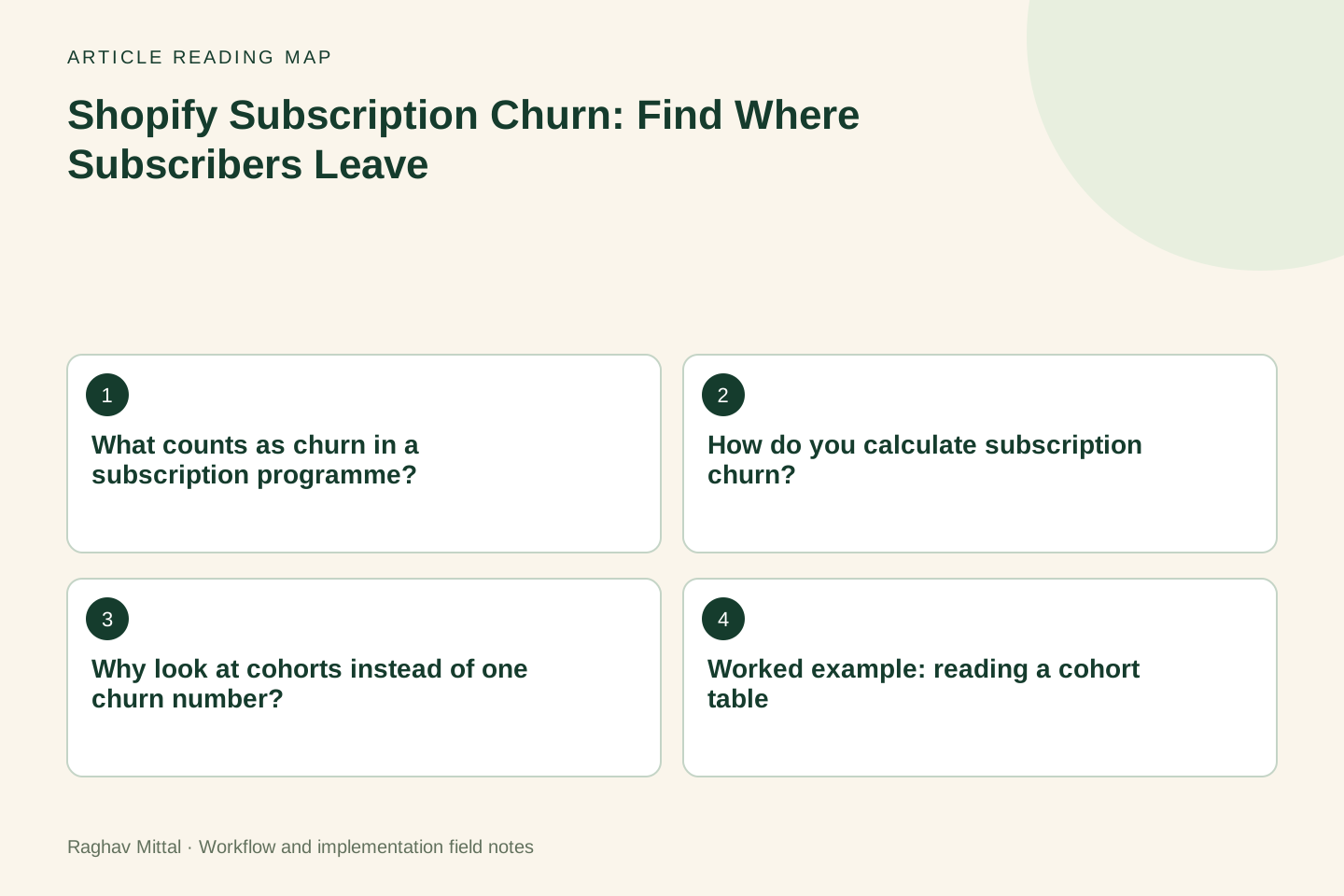
What counts as churn in a subscription programme?
A subscriber has churned when they will not be charged again unless they sign up afresh. That covers cancelled contracts, contracts that expired after a fixed number of orders, and contracts stopped after failed payments. It does not cover a skipped order or a pause with a resume date, although a long pause often ends in a cancellation and is worth tracking separately.
Agree the definition before you calculate anything. Teams often argue about a churn figure when they are really using two different definitions.
How do you calculate subscription churn?
Monthly churn rate is the number of subscribers lost during the month divided by the number active at the start of the month. Calculate it twice: once for voluntary cancellations and once for payment failures.
| Measure | Formula | What it tells you |
|---|---|---|
| Voluntary churn | Customer-initiated cancellations ÷ subscribers active at the start of the month | Whether the product, price or schedule fits |
| Involuntary churn | Contracts ended after failed payments ÷ subscribers active at the start of the month | Whether payment recovery works |
| Second-order retention | Subscribers who paid a second order ÷ subscribers who paid a first | Whether the offer attracted the right buyers |
| Recovery rate | Failed payments later paid ÷ all failed payments | How much revenue retries and reminders bring back |
A monthly rate is a summary. To see where subscribers leave, you also need a cohort view.
Why look at cohorts instead of one churn number?
A cohort is the group of customers who started in the same month. Following each cohort shows how many are still paying after one, two, three and six orders. That view answers questions a blended rate cannot:
- Do most losses happen right after the first renewal, or gradually?
- Did a change to the offer or the portal improve later cohorts?
- Do subscribers from a discount campaign leave faster than the rest?
If your app has no cohort report, build one in a spreadsheet from an export of contracts with their start date, status and number of paid orders.
Worked example: reading a cohort table
Illustrative scenario: three monthly cohorts of 100 new subscribers each.
| Cohort | Paid order 1 | Paid order 2 | Paid order 3 | Paid order 6 |
|---|---|---|---|---|
| March | 100 | 62 | 55 | 47 |
| April | 100 | 60 | 54 | 46 |
| May (after a change to the offer wording) | 100 | 74 | 66 | not yet known |
The figures are invented to show the pattern. In March and April, about four in ten subscribers left before a second order, and losses after that were small. That points at the sign-up, not at the product: buyers did not expect the renewal, or the first delivery arrived at the wrong interval. A cancellation survey sent to month-six subscribers would have looked in the wrong place.
Where do subscribers usually leave, and what does each point suggest?
| When they leave | Likely cause | Where to look |
|---|---|---|
| Before the second order | The renewal was a surprise, or the first-order discount attracted one-time buyers | Offer wording, default selection, the reminder before the first renewal |
| Around orders two to four | Too much product, wrong frequency, or no easy way to skip | Portal actions, frequency options, skip and pause usage |
| After many orders | Price change, product fatigue or a life change | Cancellation reasons, swap options, win-back offers |
| At any point, by payment failure | Expired or declined cards with weak follow-up | Retry settings and recovery messages |
How do you separate failed payments from real cancellations?
Check how your app records a contract that ends after failed billing attempts. In the Shopify Subscriptions app, the billing attempt settings let you set the number of retries, the days between them, and what happens when every retry fails: skip the order, pause the subscription or cancel it. That last choice decides whether a failed payment appears in your data as a cancellation.
If failed payments end as cancellations, tag or export them separately before you calculate voluntary churn. Otherwise a card-expiry problem looks like customers rejecting the product. The dunning strategy guide covers the recovery side in detail.
What do cancellation reasons tell you?
They are useful when the list is short, specific and reviewed monthly. A reason list with "Other" at the top produces nothing. Keep it to reasons you could act on:
- I have too much product
- It costs too much
- I only wanted to try it once
- I did not like the product
- Delivery problems
- I am switching to another brand
Read the reasons next to the cohort table. "Too much product" at order three is a frequency and skip problem. "I only wanted to try it once" at order one is an offer problem. Check what your app lets you change on a contract as well. For the Shopify Subscriptions app, the contract management documentation lists pausing, skipping an upcoming order and changing the delivery frequency. A customer who cannot find a way to skip an order will cancel instead.
What should you fix first?
Fix the stage where the largest number of subscribers is lost, and change one thing at a time so that the next cohort shows whether it worked.
- If losses are before order two, rewrite the offer and the pre-renewal reminder.
- If losses are around orders two to four, make skipping and changing frequency easy to find.
- If involuntary churn is high, review retry timing and recovery messages.
- If long-standing subscribers are leaving, look at price changes and swap options.
Record the date of each change. A cohort table is only useful if you know which cohorts saw which version.
A churn audit is the first step of my Shopify subscription growth work. If you want a second pair of eyes on yours, send me your app name, subscriber count and a contracts export with personal details removed.
Frequently asked questions
What is a good churn rate for a Shopify subscription programme?
It depends on the product, the price and how subscribers were acquired, so a benchmark from another category will mislead you. Compare your own cohorts over time instead, and judge a change by whether the next cohort keeps more subscribers at the same order number.
What is the difference between voluntary and involuntary churn?
Voluntary churn is a customer choosing to cancel. Involuntary churn is a subscription ending because a payment failed and was not recovered. The first is fixed through the offer, the product and the portal; the second through payment retries and reminders.
How many months of data do I need for a churn audit?
Enough for at least three monthly cohorts to reach their third order. For a monthly plan that is about five to six months of history. With less data you can still separate voluntary from involuntary churn and check second-order retention.

Founder, The Night Marketer (Shopify Select Partner). The agency has served 450+ brands since 2015.
Shopify Subscription Growth
I help Shopify brands build subscription programmes that customers keep. That covers choosing between Shopify Subscriptions, Recharge, Loop, Skio and similar apps, designing the subscribe-and-save offer, fixing the customer portal and cancellation flow, recovering failed payments, and migrating subscribers between apps without losing them. The Night Marketer team handles implementation.