Agree the source and destination.
Name the company, document identity, revision, voucher type and mapping owner. Record what makes a document eligible for transfer.
TallyPrime API Integration Services
I design and implement TallyPrime integrations for manufacturers, distributors, service businesses and software teams. The engagement starts with the actual source document, accounting company and approval process. We select a supported file, connector or API route, prove the important cases in a test company, and give operators a way to identify and resolve uncertain transfers.

Scope, cost and delivery
A documented source-to-voucher contract, a small test-company pilot and a reconciliation result before wider rollout.
Installed release and hosting; source-system access; company and voucher count; master quality; approval rules; recovery and maintenance.
The proposal separates discovery, implementation and ongoing support. Software licences, hosting and usage charges are identified separately. We confirm the price against your samples and acceptance criteria before implementation starts.
Indicative planning ranges for the focused scope above, starting once access and samples are ready. These are estimates; the proposal confirms dates and dependencies.
Bring normal, changed and failed source documents. We can demonstrate the proposed mapping and reconciliation approach. The method comparison below helps select a route; it does not claim a measured client result.
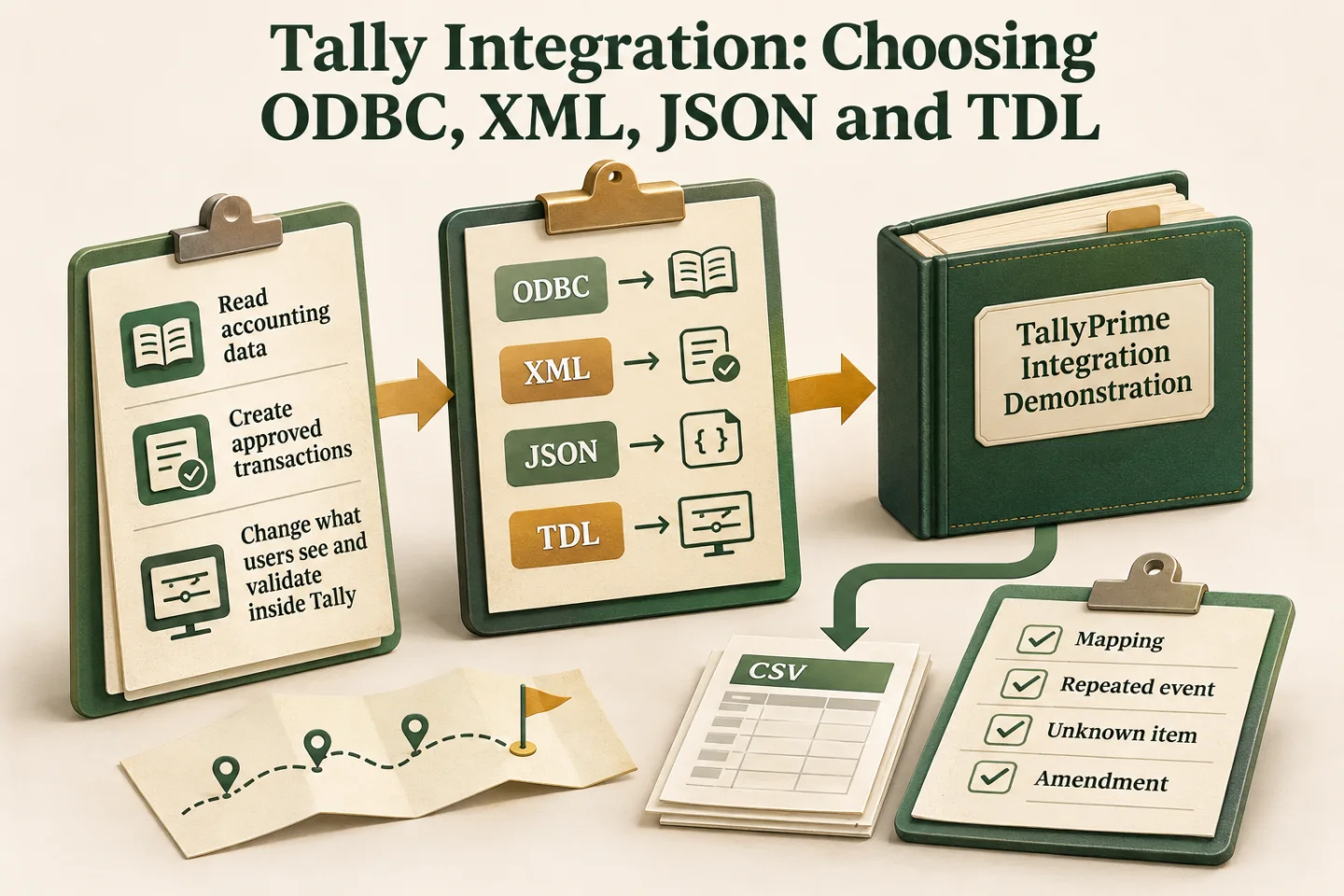
Tally integration-method comparison →Before you commit, agree which sample records, screens or reports the pilot must demonstrate and who will accept them. Any before-and-after result needs an agreed baseline and measurement period.
Tell me which system must connect to Tally and which records are currently entered twice.
Scope my Tally integration →Agree a small deliverable, fee and acceptance checks in writing. Review the work, pay after acceptance and decide whether to continue. Remote delivery in English, led by Raghav with The Night Marketer.
Integration design demonstration
This downloadable fixture models the transfer decisions before connecting to an accounting company. It does not post to TallyPrime. Production acceptance still requires your installed release, approved ledgers and an authorised test company.
Scroll the example table sideways to read every column.
| Source event | Mapping or check | Expected result |
|---|---|---|
| INV-DEMO-101 / revision 1 | DEMO-CO + invoice ID + revision identifies the operation; ITEM-A maps to Demo component A; 10 × 500 = 5,000. | Create one proposed voucher instruction for 5,000. This simplified fixture excludes tax. |
| INV-DEMO-101 / revision 1 again | The same operation and amount have already been accepted by the simulation. | Skip the replay; proposed voucher count remains one. |
| INV-DEMO-102 / revision 1 | ITEM-UNKNOWN has no approved stock-item mapping. | Hold the document for the mapping owner; no proposed voucher. |
| INV-DEMO-101 / revision 2 | The same invoice now has a different approved source revision. | Send the amendment to accounts review; do not silently create a second sale. |
Fixture result: four events, one proposed voucher for 5,000, one skipped replay, one mapping hold and one amendment review. An uncertain network result would require a destination lookup; this offline fixture does not test a connector or Tally response.
To reproduce the offline checks, extract the complete pack and run python3 verify_examples.py in that folder. Python 3 is required; the checker uses no network connection.
We agree a document-level contract before choosing technology. TallyPrime supports integration through documented formats and interfaces; the available route depends on the installed release, company access and deployment. A REST-facing bridge can be part of the design, but it should not be confused with a universal cloud endpoint built into every installation. Existing software and finance owners approve which records the connection may create or change.
Retain the source company, document identity, revision and relevant line details. A CRM stage change becomes an accounting instruction only under the agreed approval rule.
Resolve customer, item, unit, ledger and voucher-type references. Hold the whole document when a required line cannot be mapped.
Use the supported connector, import or API path. Retain the application result and destination voucher reference; a successful network response alone is insufficient.
Compare approved source records with confirmed destination records. Assign mismatches and uncertain outcomes before retrying a batch.
Illustrative design: a distributor approves one order for two partial dispatches. The CRM remains the owner of the order, the dispatch system records the supplied quantities, and accounts approves the corresponding invoice instruction. If a transfer times out, the integration looks for the intended voucher before resending. The second dispatch has its own operation identity rather than reusing the first approval. This describes a proposed workflow, not a claimed client result.
The specification names the source identifier, target company and voucher type for every operation. Customer and item mappings include units, effective dates and the owner who approves additions. A rejected mapping stays visible with a reason rather than falling back to a plausible but incorrect master.
The proposed architecture separates source capture, approved work, transfer results and reconciliation. It can use a local connector and an authenticated integration service where appropriate. The discovery review establishes how the installed Tally environment can communicate without making the accounting endpoint broadly accessible.
The pilot includes a normal document, an unknown master, a duplicate delivery, a partial batch result and a source correction. Accounts compares counts, values and the references needed to locate each voucher. Operators practise an uncertain outcome using the runbook rather than asking a developer to reset a flag.
Historical migration and ongoing transfer are scoped separately. The proposal states the records included, expected update interval, unresolved dependencies and support responsibility. Delivery dates and price follow that scope; company count alone does not describe the work.
Party GSTINs, state codes, HSN codes and tax rates have to agree between the source application and Tally. The integration checks them before posting and sends a mismatch to review, rather than creating a second ledger or stock item with different tax details.
Where TallyPrime or an authorised provider generates e-invoices and e-way bills, the integration records which system owns that step and writes the IRN or e-way bill number back to the source record. A retried transfer is checked against that number first, so it never asks for a second one.
| Approach | Good fit | Check before committing |
|---|---|---|
| Reviewed file transfer | Stable periodic batches and an accounts team controlling the posting window. | Freeze the export contract, retain source totals and test repeated imports. |
| Existing connector | Standard document types that a maintained connector already supports. | Test the actual item, tax, company and amendment cases; review support and upgrade ownership. |
| Custom integration | Several systems, custom document relationships or approval and recovery requirements. | Agree data contracts, access, delivery evidence and operator recovery before implementation. |
Swipe sideways to see all columns.
Learn about The Night Marketer team and read its Shopify Partner Directory profile.
The pattern behind the request
Connect approved orders, invoices, inventory and customer records to TallyPrime with maintained mappings, confirmed results and reconciliation.
A clear path, not a black box
Agree the document contract first. Test normal transfers, failed mappings and uncertain outcomes before expanding to more companies or document types.
Name the company, document identity, revision, voucher type and mapping owner. Record what makes a document eligible for transfer.
Run approved records in a test company. Compare counts, amounts and voucher references, then repeat a batch and investigate uncertain results.
Release the agreed flow with alerts, reconciliation and an operator runbook. Keep corrections and retries traceable to the original source.
What gets built
These deliverables let accounts establish what arrived, what changed and what still needs review without relying on a success message alone.
Identify which application approves each record and which accounting company receives it.
Document source keys, item units, ledgers and amendment rules before sending data.
Select the route against the installed release and the actual document types.
Check accepted, rejected, repeated and changed documents against destination evidence.
Name the owner for mapping failures, uncertain transfers and release compatibility.

Direct access, execution depth
I diagnose the problem and stay responsible for the path to delivery. When the work needs design, engineering, SEO, automation, or specialist support, The Night Marketer team adds depth without making you coordinate the room.
Common questions
Yes. We start with the records and permissions the actual systems expose, define source ownership and approved mappings, then choose a supported transfer method. A pilot proves the relevant document types and recovery cases before wider rollout.
No. The installed release, configuration, company access and connection method matter. We verify the target setup and supported formats rather than assuming that a generic REST endpoint covers every version.
Use a maintained connector when its supported documents, mappings, exception handling and support cover the requirement. Custom work is appropriate for demonstrated gaps. The discovery review compares both against the same acceptance cases.
The estimate follows a review of source formats, company count, voucher types, mapping complexity, historical data, approvals and support. The proposal defines a bounded pilot, acceptance evidence and the dependencies needed for rollout.
Yes. Changes inside Tally are scoped as TDL customisation. When a project needs both an external connection and an in-product report or control, we document and test those parts separately.
Keep exploring
These are practical reads for understanding the job, asking better questions, and spotting the risks that are easy to miss in a first call.