Key takeaways
- Evaluate both approaches against the same real transaction examples.
- A feature list does not demonstrate mapping and recovery behaviour.
- Include upgrade, support and operating work in the comparison.
- Build custom components only for a defined gap in the required workflow.
Putting this workflow into practice? Explore TallyPrime API Integration Services for implementation scope, controls, and next steps.
A ready-made connector can save development work when it supports the documents and operating rules a business actually uses. Custom integration can make sense when an important requirement remains uncovered. The buying mistake is deciding between them before defining the records, approvals and recovery behaviour the team needs.
Use one acceptance brief for both options. A connector vendor and a custom developer should be able to show how the same normal and difficult transactions move from source to confirmed accounting result. This turns a broad feature comparison into a decision the operations and finance owners can assess together.
Define the job before comparing the products
List the source application, destination Tally company, installed release and relevant document types. Describe the approved business event and the information that makes it eligible for transfer. A generic requirement to sync sales can hide orders, invoices, receipts, returns and cancellations with different meanings.
For an illustrative distributor, the requirement might be approved invoices from a billing application into one Tally company, followed by a daily reconciliation. If a second branch uses a different item map and company, write that as another explicit requirement. Do not assume that a product's multi-company label covers the intended routing rule.
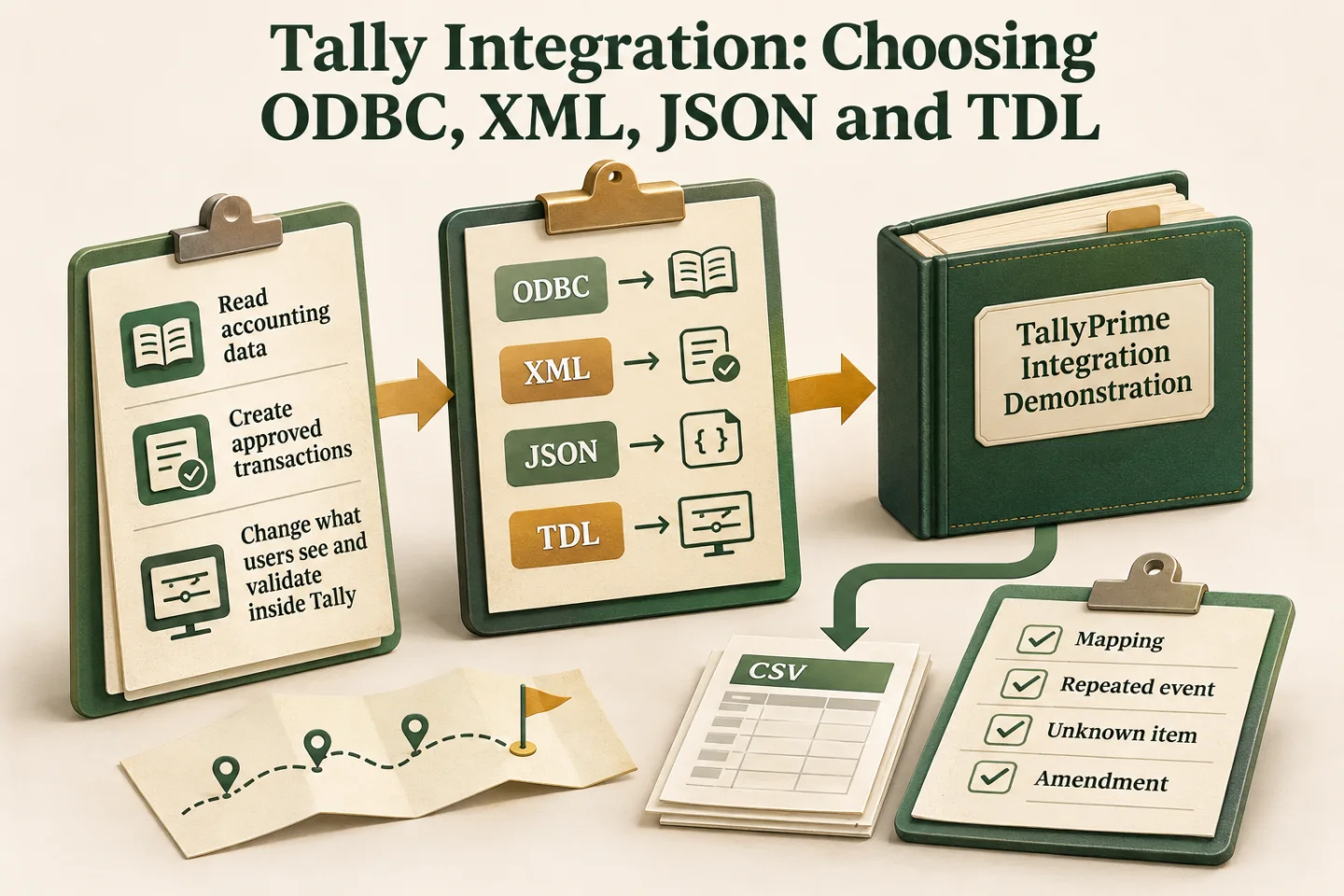
Tally's integration guide establishes the supported connection categories. Its integration prerequisites help identify installation dependencies. These checks belong in both proposals, not only in the custom-development estimate.
Make a fixture pack from ordinary work
Choose a normal transaction, a new or ambiguous master, a corrected document, a partial result and a failed-response scenario. Add the difficult cases that actually occur in the business, such as split dispatches, discounts, multiple units or a cancellation after posting.
Redact private information without removing the relationships being tested. The reviewer still needs to see whether several lines form one document and whether the same customer code can occur in two companies. Keep the expected outcome beside each fixture.
A demonstration that imports one simple invoice establishes that one case. It does not establish that all relevant exceptions, corrections and retries are supported. Ask to inspect the destination result and the operator's recovery view, rather than only the transfer screen.
Compare requirements at the same level
| Decision area | Evidence from a connector | Evidence from a custom proposal |
|---|---|---|
| Document coverage | Supported objects demonstrated with fixtures | Explicit included and excluded document flows |
| Mapping | Maintained company, item and ledger rules | Mapping specification and approval ownership |
| Repeated delivery | Demonstrated handling of the same source operation | Defined identity and destination confirmation design |
| Partial failure | Per-document results and recovery steps | Result model, exception queue and runbook |
| Upgrade support | Supported releases and vendor maintenance terms | Compatibility fixtures and named support responsibility |
| Handover | Configuration access and operator documentation | Agreed package/source access and operating documentation |
Keep unsupported or untested cases visible. A blank comparison cell should lead to a question, not an assumption that either option can solve the requirement later without extra work.
Inspect recovery before discussing convenience
Ask what the operator sees when the source sends a document but the response is lost. The integration needs to distinguish a confirmed failure from an uncertain outcome. A generic retry button can be dangerous when nobody knows whether the destination already accepted the record.
Check how a partially successful batch is represented. If nine documents succeeded and one failed, the team should be able to reconcile those nine and resolve the remaining one without blindly rerunning the whole file.
Also ask how an approved correction is applied. Some workflows need an alteration, some need a separate adjustment, and others require human review. The tool should follow the authorised accounting process instead of making the choice merely because it supports an update call.
Distinguish configuration from development
A connector may support custom mappings through configuration. A custom build may depend on a standard connector for transport. These approaches are not always mutually exclusive. Record which component owns each requirement and who maintains the connection between them.
Changes inside Tally, such as a new voucher field or report, belong to a separate customisation scope. Tally's integration methods documentation distinguishes in-product TDL work from external data exchange. A connector's ability to move data should not be taken as evidence that it can change an operator's screen.
If an add-on is involved, establish its installation and compatibility requirements. The business needs a clear explanation of what will be loaded, who supports it and what happens when another existing customisation touches the same workflow.
Compare the total work after launch
Include licence or subscription charges where applicable, setup, mapping changes, monitoring, exception handling, release testing and support. Use the actual vendor quote or proposed commercial terms. An invented monthly saving or generic project price does not make the comparison more useful.
Ask who owns a problem that crosses systems. If the CRM event is present but the Tally voucher is missing, the team should not have to guess which vendor to contact. The operating agreement needs a responsible coordinator and the evidence each party will inspect.
Consider what happens when an item or ledger changes. A connector with a strong vendor-maintained mapping process may be easier to operate than an undocumented custom build. Conversely, a custom workflow with explicit ownership may be necessary when the business rule cannot be represented in the connector's configuration.
Choose the smallest approach that proves the requirement
Start with a bounded pilot and agreed acceptance evidence. If a maintained connector covers the fixture pack and support needs, there may be no reason to commission a replacement. If it misses a specific approval or relationship, estimate that gap rather than assuming the entire connection needs rebuilding.
When a requirement remains uncertain, record a discovery task and its decision criterion. Avoid turning uncertainty into an unconditional delivery promise. The outcome of a pilot can be a simpler configuration, a connector plus a small extension, or a custom integration with an explicit support plan.
Implementation work to scope
- Write the document, company and approval requirements once.
- Prepare representative fixtures with finance-approved expected outcomes.
- Test mapping, retries, corrections and partial failures for each option.
- Compare access, configuration, upgrade and support responsibilities.
- Select the approach that meets the acceptance brief with sustainable operating work.
The API versus file-import guide covers transfer choices. The Tally deployment checklist helps when an add-on is part of the solution. Review TallyPrime integration services, TDL development, or share the connector and workflow you are considering.
Frequently asked questions
When is a ready-made Tally connector a good fit?
It can fit when its supported source documents, company routing, mappings and recovery process match the actual workflow. Test representative transactions and exceptions in the installed setup. A feature list alone does not prove compatibility with the required accounting outcome.
What should a custom connector proposal explain?
Ask for the supported interfaces, field and company mappings, source-document identity, approval boundaries, exception handling and maintenance responsibility. Compare the ongoing operating work as well as the initial build scope when deciding between options.

Founder, The Night Marketer (Shopify Select Partner). The agency has served 450+ brands since 2015.
TallyPrime API Integration Services
I design and implement TallyPrime integrations for manufacturers, distributors, service businesses and software teams. The engagement starts with the actual source document, accounting company and approval process. We select a supported file, connector or API route, prove the important cases in a test company, and give operators a way to identify and resolve uncertain transfers.