Key takeaways
- An integration estimate needs a defined document flow and acceptance criteria.
- Company count matters alongside mappings, transaction relationships and exceptions.
- Separate discovery, implementation, historical migration and ongoing support.
- Compare proposals by included operating work rather than an isolated build price.
Putting this workflow into practice? Explore TallyPrime API Integration Services for implementation scope, controls, and next steps.
Two businesses can both ask for a CRM-to-Tally connection and need very different projects. One has a stable daily export of approved invoices into a single company. The other needs several branches, partial dispatches, custom fields, historical migration and a review queue for corrections. The label integration does not explain the difference in work.
TallyPrime integration cost in India is best discussed through a scope the buyer can inspect. This guide explains the factors to include in an estimate and the evidence that makes a proposal comparable. It does not publish a universal price range: an actual quote needs the relevant systems, documents and delivery responsibilities to be understood first.
Start with one business outcome
Describe the first completed flow in operational terms. For example, approved invoices from the billing system reach the intended Tally company, receive confirmed voucher references and reconcile to a daily source batch. That is a clearer estimating unit than automate accounts.
State what is excluded from the pilot. Receipts, credit adjustments, historical balances and stock transfers may each need different mappings and tests. A small pilot can be useful without pretending that it covers the whole finance operation.
Name the people who approve source data, accounting treatment and acceptance results. If those decisions are unresolved, discovery work is needed before implementation can be estimated responsibly. The proposal should distinguish that work rather than hide it in an unexplained contingency.
Count document relationships as well as document types
A simple invoice transfer differs from a workflow where one order produces several deliveries and one bill covers several jobs. Record those relationships because they determine how source identities, quantities and corrections are represented.
Company and branch count also affect scope. Two companies sharing a well-maintained mapping can be easier to onboard than one company with several inconsistent source code systems. Ask how mappings are created, approved and maintained, not just how many ledgers exist.
Tally's objects and collections reference provides context for the record structure. The estimate still needs the actual source examples to establish which object relationships the implementation must preserve.
Identify the main estimating factors
| Scope factor | Evidence needed before quoting | Work it can create |
|---|---|---|
| Source systems | API/export samples and access model | Capture, authentication and format handling |
| Accounting companies | Company routing and separation rules | Mapping, isolation and onboarding checks |
| Document flows | Normal, corrected and cancelled examples | Transformation and lifecycle handling |
| Master data | Customer, item, unit and ledger differences | Mapping cleanup and approval queues |
| Historical data | Period, population and balance requirements | Migration rehearsal and reconciliation |
| Operating requirements | Monitoring, support and recovery ownership | Runbooks, alerting and ongoing maintenance |
Keep optional items separate from required pilot work. A buyer should be able to see what changes when a second company, document flow or approval stage is added.
Check the installed Tally environment
Confirm the release, hosting arrangement, connectivity and company access. Tally's integration prerequisites and integration guide are the technical starting points. They do not replace an inspection of the customer's configured environment.
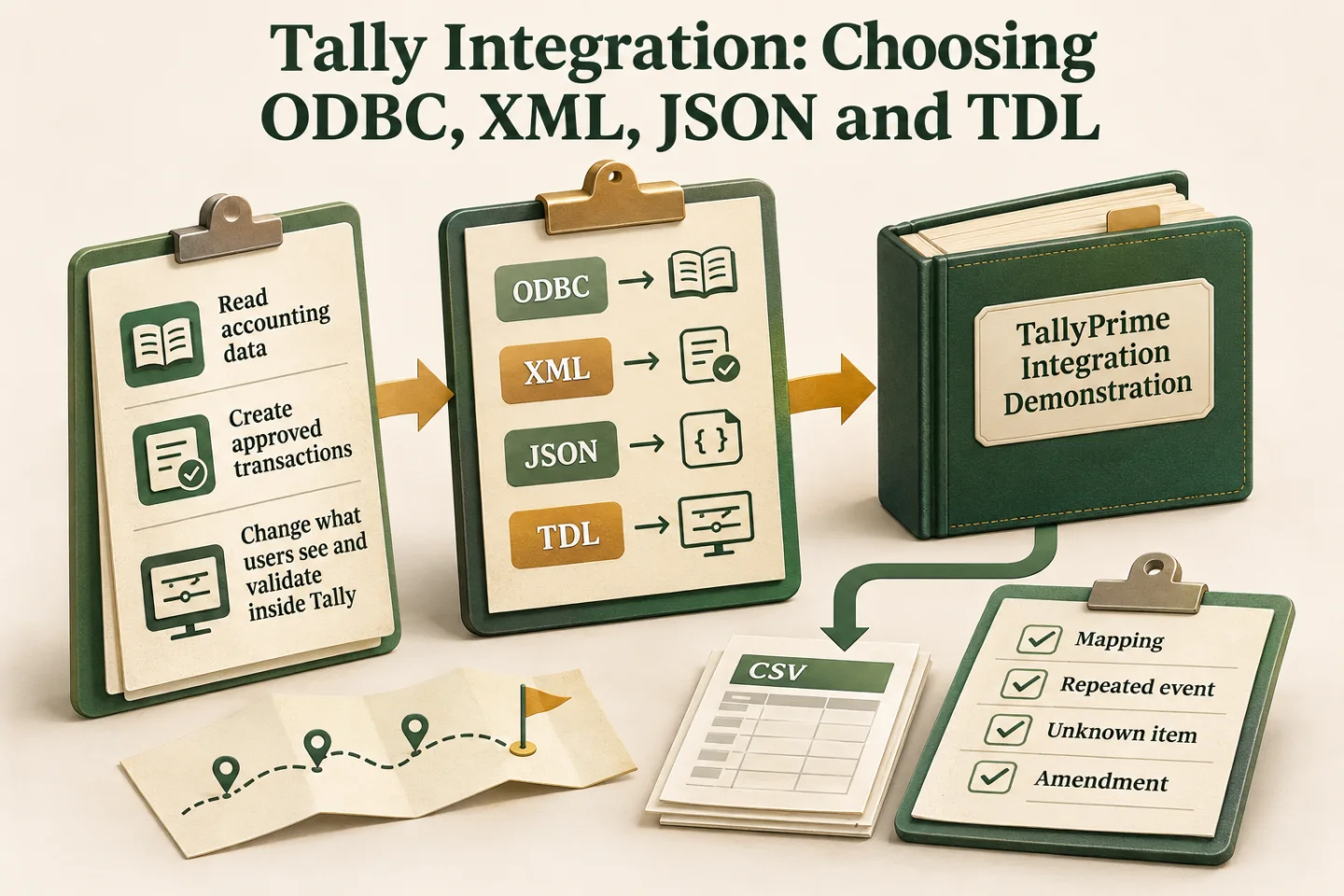
A reviewed file import may be sufficient for periodic supervised transfers. A maintained connector may cover standard documents. A custom integration may be needed for an unsupported relationship or approval process. Evaluate the available approaches before assuming that a custom API build is the default.
If the requirement includes a field, validation or report inside Tally, identify the TDL scope separately. External data exchange and in-product customisation have different acceptance and upgrade requirements, even when they are delivered in the same engagement.
Include exception handling in the estimate
A normal successful transfer is only part of delivery. The operator needs to identify an unknown master, a partial batch failure, a source correction and a request with an uncertain destination outcome. Each case needs a defined state and an accountable next action.
The estimate should describe which recovery cases will be demonstrated. If a transfer times out after the destination accepts it, the workflow needs evidence to decide whether to resend. Omitting that work can leave the team with a low build price and a high recurring reconciliation burden.
Data cleanup may also be a separate task. Record whether the client supplies approved mappings or the delivery team helps establish them. Avoid comparing two prices as equivalent when one includes master cleanup and the other assumes clean data will arrive ready to use.
Separate historical migration from ongoing transfer
Migration has a population, cutoff and acceptance balance. Ongoing integration has recurring events, revisions and operating ownership. Their testing can overlap, but they are not the same deliverable.
For an illustrative cutover, decide whether the destination receives full transaction history or approved opening balances plus new activity. Define where unresolved documents remain during the transition. A proposal should identify who signs off the resulting balances and who controls the last source changes.
If migration is optional, show its assumptions and price basis separately. That allows the buyer to compare an operational pilot without accidentally accepting responsibility for a historical data exercise that has not been scoped.
Compare delivery and support terms
A useful proposal identifies discovery outputs, pilot deliverables, acceptance fixtures, deployment dependencies, documentation and support. It states who maintains credentials, mapping changes, the connector and compatibility checks when systems are upgraded.
Distinguish recurring vendor fees from implementation and maintenance work. Use the actual applicable terms, including any commercial assumptions that affect the estimate. A single headline amount is not a complete comparison when the proposals include different ongoing obligations.
Do not evaluate the project only through expected time savings. Establish a baseline for repeated entry, unresolved transfers and reconciliation work. Compare the pilot with that baseline before making a return-on-investment claim or expanding the rollout.
Implementation work to scope
- Define one completed source-to-accounting flow and its exclusions.
- Collect representative documents, company context and access information.
- Agree mapping ownership, exception cases and acceptance evidence.
- Separate migration, additional flows and ongoing support in the proposal.
- Prove the pilot and use its results to estimate the next expansion.
Use the automation ROI baseline guide to plan measurement, and the Tally import pilot guide to prepare a controlled trial. For a scoped estimate, explore TallyPrime integration services or share a redacted source document and the result you need.
Frequently asked questions
Why can two Tally integration quotations differ substantially?
They may cover different documents, companies, mapping work, connection methods, recovery controls and support responsibilities. Compare a shared scope and acceptance pack before comparing the totals. A low estimate may exclude work another proposal includes.
What belongs in the running-cost estimate?
Include connector hosting or operation where needed, source-platform charges, monitoring, maintenance, release testing and the team's exception-review time. Keep estimated assumptions visible and confirm vendor charges for the actual account and configuration.

Founder, The Night Marketer (Shopify Select Partner). The agency has served 450+ brands since 2015.
TallyPrime API Integration Services
I design and implement TallyPrime integrations for manufacturers, distributors, service businesses and software teams. The engagement starts with the actual source document, accounting company and approval process. We select a supported file, connector or API route, prove the important cases in a test company, and give operators a way to identify and resolve uncertain transfers.