Key takeaways
- Order, payment, refund, return and payout events need separate meanings.
- Choose stock ownership for each item and location before enabling updates.
- Check the financial result behind a refund rather than its existence alone.
- Reconcile complete commerce populations independently of webhook attempts.
Putting this workflow into practice? Explore Shopify–Tally Integration Services for implementation scope, controls, and next steps.
A Shopify order export can be a useful accounting input, but it is not a complete description of what happens after checkout. An order can be edited, partly fulfilled, refunded without a stock return or settled in a payout containing fees and other transactions. A Shopify–Tally integration needs to represent those differences.
Start with one store, one accounting company and a representative set of orders. Agree the event that makes a record eligible for accounts, the owner of inventory and the evidence that confirms a transfer. The integration should help operations and accounts explain the same transaction without asking either team to maintain another private workbook.
Define when an order becomes eligible
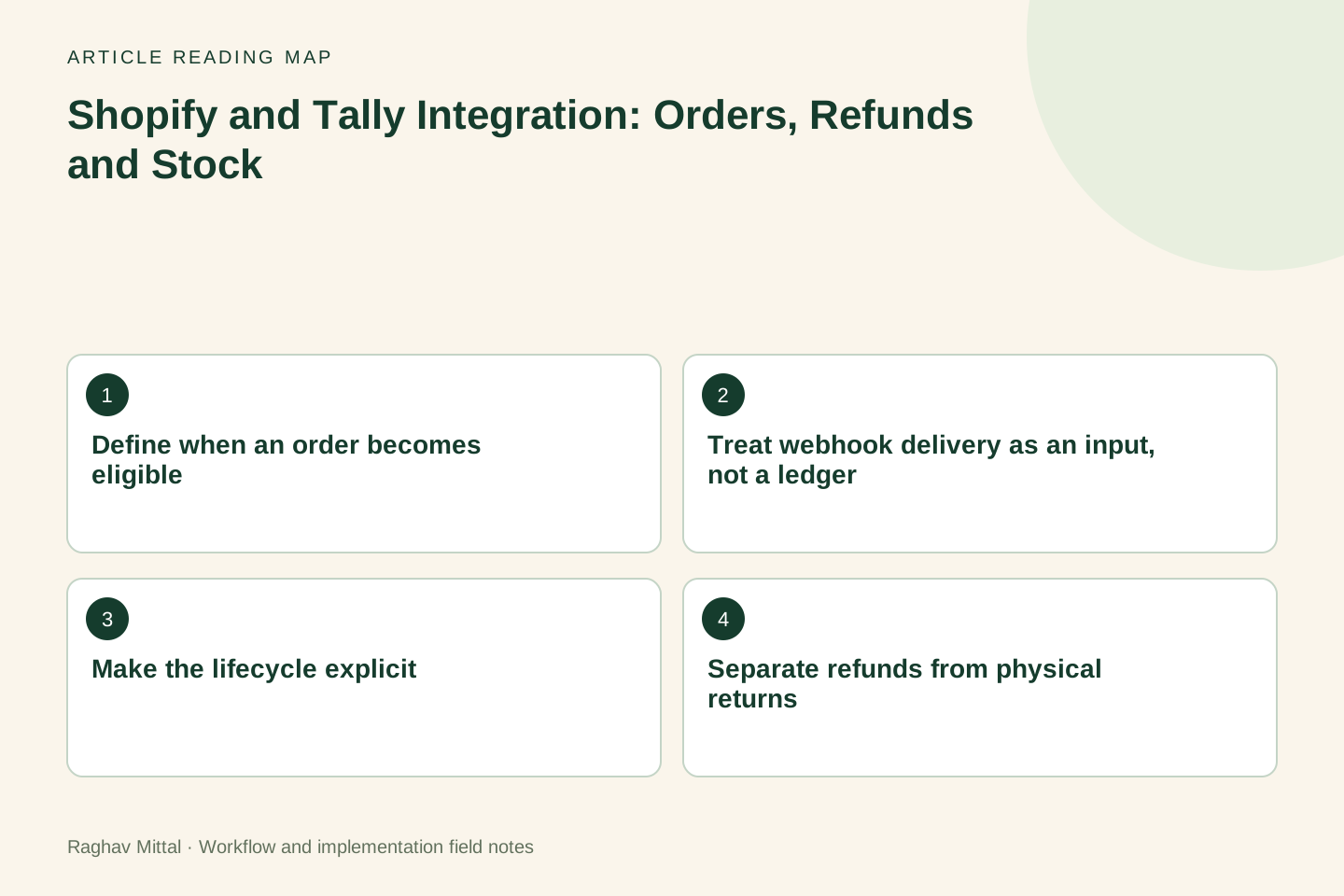
Some workflows need an approved invoice instruction after payment; others depend on dispatch or a separate finance review. Confirm the business rule and any required accounting treatment with the responsible team. A technical order-created event should not silently decide the posting policy.
Capture the store, order identity, relevant revision, line items, discounts, shipping and payment context. Keep a later change linked to the original record. If an order is cancelled before accounting eligibility, the integration should be able to explain why it never produced a voucher.
For an illustrative order containing two products, preserve the allocation of a discount and shipping according to the approved mapping. A correct order grand total does not prove that the item and ledger details are correct. Accounts needs an agreed comparison at the same level of detail.
Treat webhook delivery as an input, not a ledger
Shopify's webhook delivery verification guidance is the reference for validating incoming deliveries. The implementation also needs a maintained work record so that receiving an event and completing the accounting operation are distinguishable.
Repeated or delayed events should not produce repeated accounting actions. Identify the same logical source operation consistently, record what has been confirmed, and define how later revisions are handled. Test the behaviour with the actual selected Shopify API version and app access.
A reconciliation process should compare the intended source population with the destination independently of individual notifications. This catches a different class of failure: a relevant source record that never reached the processing queue at all.
Make the lifecycle explicit
| Commerce record | What it helps describe | Separate question to resolve |
|---|---|---|
| Order | What the customer requested | Is it eligible for the accounting instruction? |
| Payment transaction | Financial processing result | Has the required result actually succeeded? |
| Fulfilment | Supplied or shipped items | Which quantity belongs to this delivery? |
| Refund | Refunded components and related transactions | What is the financial result and approved accounting treatment? |
| Return/restock event | Physical goods and stock handling | Where is the material now and can it be sold? |
| Payout | Settlement to the merchant | Which fees and timing differences explain the bank amount? |
These records may be related without being interchangeable. A workflow that turns every refund into a stock addition makes a warehouse decision from incomplete evidence.
Separate refunds from physical returns
Shopify's Refund object documentation distinguishes the refund record from the result of its associated payment transactions. Its Return object documentation describes the return workflow. Use those meanings when designing the connection.
Consider an illustrative partial refund for one damaged item that the customer keeps. The approved accounting adjustment may need to reflect the refund, but no item has physically returned to a warehouse. Conversely, goods may arrive for inspection before a refund is completed.
Record the original order, refund identity, relevant amount, transaction result and approved adjustment reference. Preserve a failed or pending financial outcome as such. A simple refund exists flag is not sufficient evidence that money reached the customer.
Choose the owner of stock by SKU and location
Define which system owns on-hand stock, reservations, available-to-sell quantities and adjustments. Tally's accounting stock balance and Shopify's saleable inventory can represent different states, particularly when goods are allocated, damaged or awaiting inspection.
Avoid enabling updates in both directions without a rule for which event is authoritative. One change can otherwise be sent back as another change, or a later snapshot can overwrite a more recent operational decision.
Test a partial fulfilment, cancelled allocation, return without restocking and transfer between locations. Ask the warehouse owner to approve the expected result for each fixture. The chosen connector must demonstrate those results rather than merely list inventory sync among its features.
Reconcile orders and payouts separately
The total value of orders is not necessarily the amount deposited into the bank. Refund timing, fees and settlement periods can produce legitimate differences. Define an order-to-voucher comparison and a separate payout-to-bank comparison, with the records and cutoff appropriate to each.
For order reconciliation, compare document identities, item quantities and approved values. For settlement reconciliation, retain the payment-provider references and explanations of adjustments. Do not fix a settlement difference by changing an otherwise correct invoice without the normal accounting review.
Keep the original source snapshot or export associated with a review batch. If a later edit changes a previously reconciled order, route it through a defined correction process instead of replacing the evidence of the earlier review.
Compare a connector and a custom workflow fairly
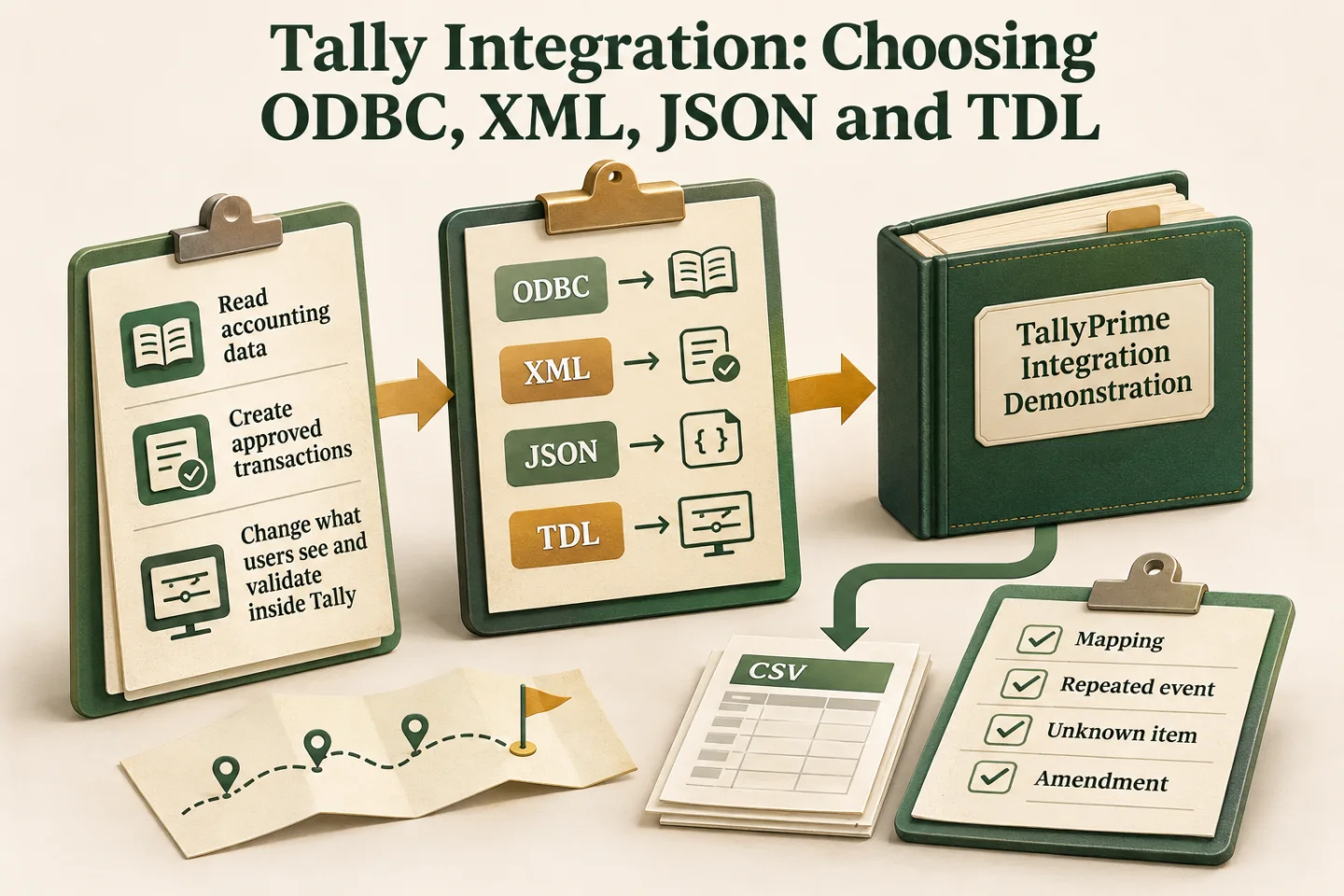
Tally's integration guide describes the available destination approaches. Check the installed release and selected connector against the real fixture pack. A maintained standard connector can be the right choice when its mappings, exceptions and support cover the work.
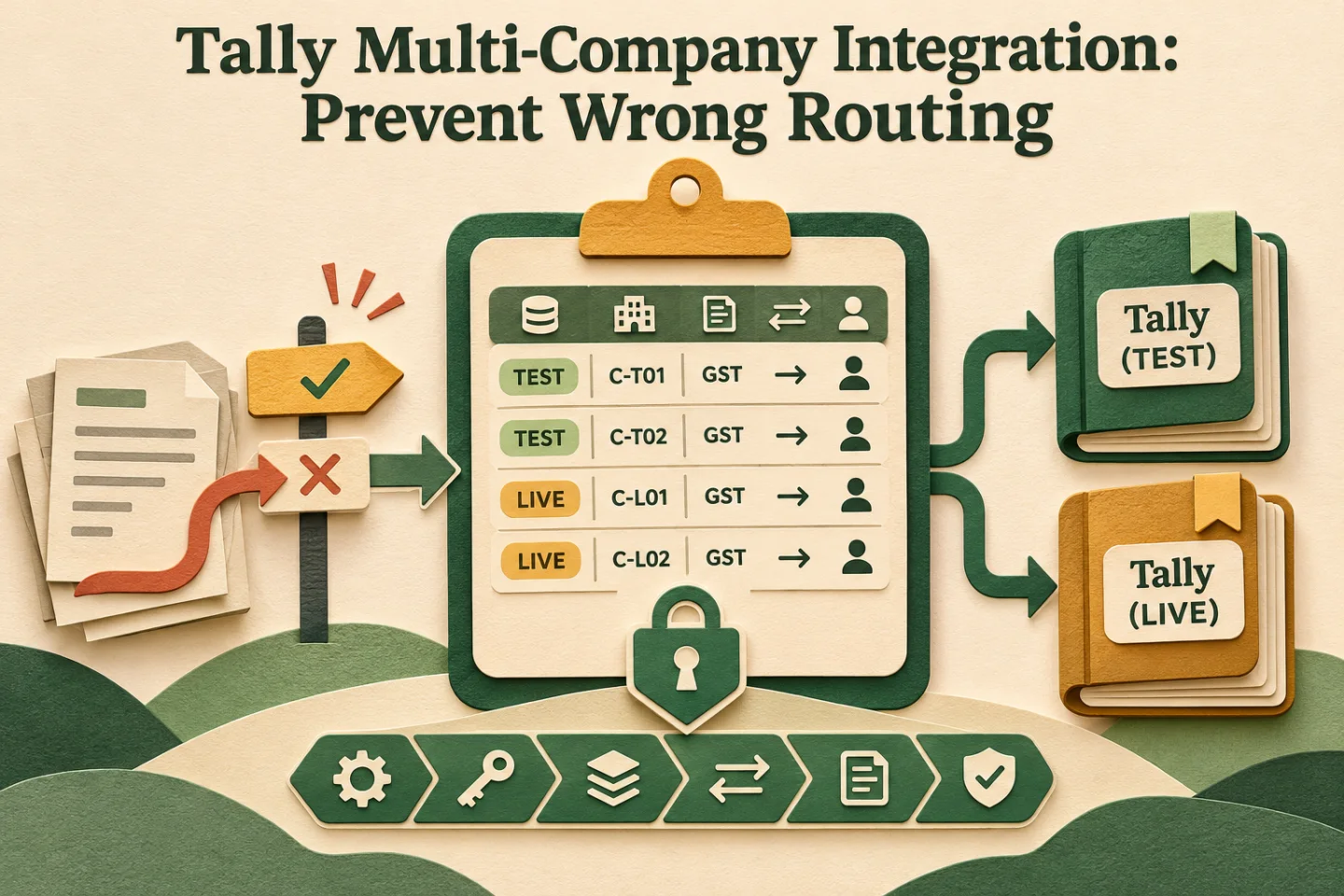
Custom development should address a demonstrated gap, such as an approval rule, multiple-company allocation or unsupported lifecycle relationship. Record the owner of the resulting integration, its monitored failure conditions and its upgrade responsibilities.
WooCommerce is a separate source implementation. The same ownership questions remain useful, but its events, permissions and data structures require their own documentation and tests. A Shopify implementation should not be represented as automatically supporting another platform.
Implementation work to scope
- Define order eligibility and finance-approved mappings.
- Map order, refund, return and payout identities separately.
- Agree stock ownership for every relevant SKU and location.
- Test lifecycle fixtures, repeated deliveries and uncertain Tally outcomes.
- Reconcile the pilot and hand over exception and recovery procedures.
Read duplicate voucher prevention and split settlement reconciliation for the supporting controls. Explore Shopify–Tally integration services or bring a normal order and a difficult refund example to scope the connection.
Frequently asked questions
Should every Shopify refund increase inventory in Tally?
No. A financial refund and a physical stock return are separate facts. Agree the original transaction reference, refund treatment, inspection outcome and stock owner before changing inventory. A refund without a returned item must remain explainable.
Which system should control available stock?
Choose the owner for each inventory decision and document how the other systems receive confirmed updates. Shopify, a warehouse and Tally may hold different operational views. Avoid allowing several connectors to independently overwrite the same available quantity.

Founder, The Night Marketer (Shopify Select Partner). The agency has served 450+ brands since 2015.
Shopify–Tally Integration Services
I help D2C and multichannel teams connect Shopify commerce records with TallyPrime accounting. We define when an order becomes eligible for posting, which system owns stock, how refunds and cancellations are handled, and who resolves exceptions. The Night Marketer team supports implementation around the chosen connector or custom integration.