Article overview
- An international product page should explain the delivery promise for the customer's destination before the buyer has to contact support.
- This guide covers the operating brief behind that explanation. It does not determine customs treatment or promise a carrier's delivery performance.
- “Ships in two days” and “arrives in two days” describe different events. Record which one a product message represents.
- Define when the clock starts. Payment confirmation, an order cut-off and a non-working day can affect the operating promise. The interface should expose material conditions rather than leaving support to explain them after purchase.
Putting this workflow into practice? Explore Shopify CRO Consulting for implementation scope, controls, and next steps.
An international product page should explain the delivery promise for the customer's destination before the buyer has to contact support. Connect the product's dispatch lead time, destination eligibility and shipping conditions to the information shown near the purchase decision. Avoid presenting a universal arrival date when the actual service depends on location or stock.
This guide covers the operating brief behind that explanation. It does not determine customs treatment or promise a carrier's delivery performance. The commercial and logistics owners should approve the actual rules before they appear on the storefront.
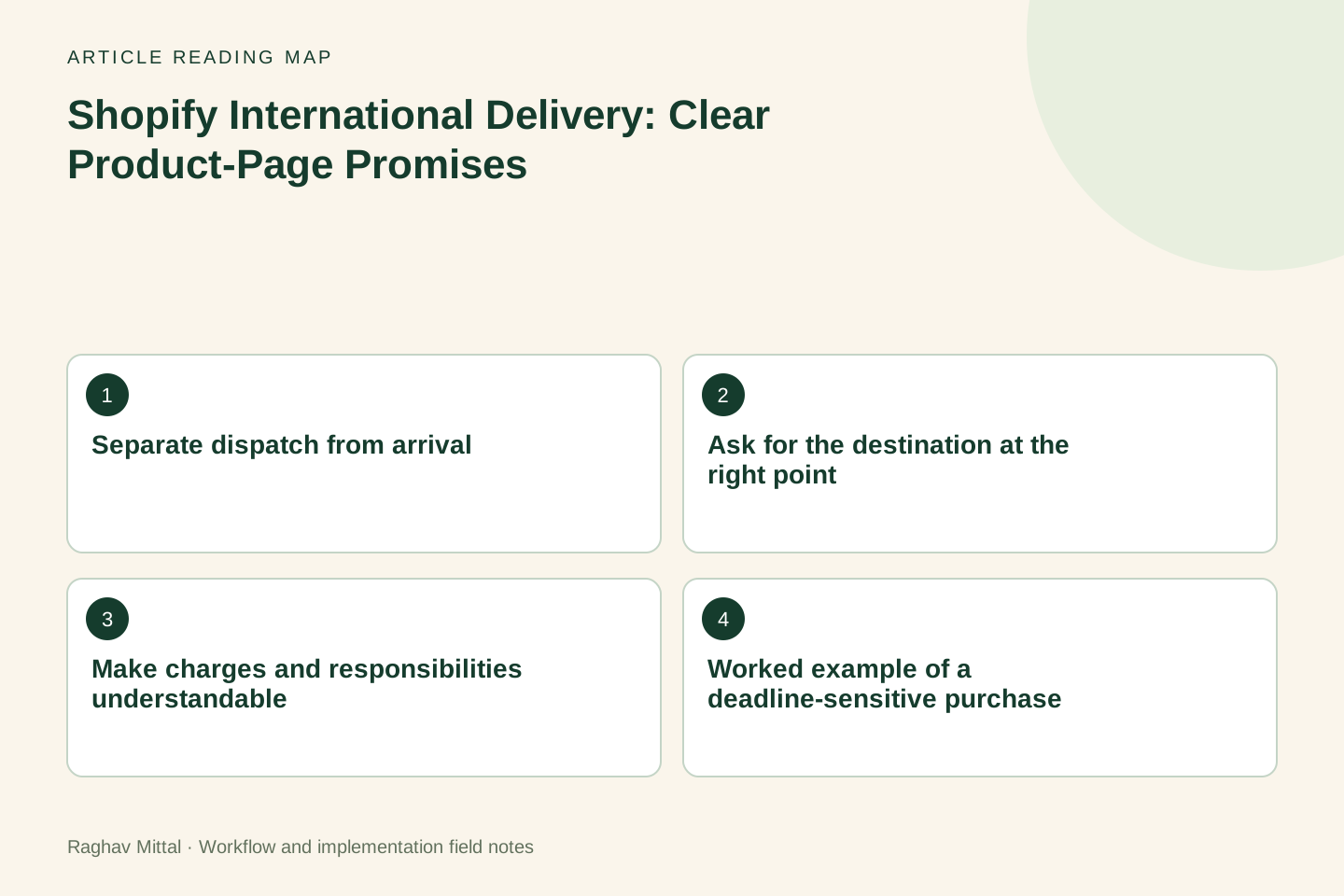
Separate dispatch from arrival
“Ships in two days” and “arrives in two days” describe different events. Record which one a product message represents. A made-to-order variant can have a different preparation time from an item already available in the warehouse, even when both share a product template.
Define when the clock starts. Payment confirmation, an order cut-off and a non-working day can affect the operating promise. The interface should expose material conditions rather than leaving support to explain them after purchase. Keep the underlying rule with a named owner so a later theme edit does not create a second promise.
Ask for the destination at the right point
Let the buyer identify the relevant country or area without discarding the selected variant. Explain what the estimate includes and what still depends on address or checkout information. An unsupported destination needs a clear outcome, not a generic estimate that remains on screen.
On mobile, check the keyboard, location selection and return to the purchase control. The mobile product-page audit provides a broader task sequence. Here the acceptance question is narrower: can a buyer understand the delivery condition for this product and destination?
Make charges and responsibilities understandable
Shopify's duties and import taxes documentation describes considerations for cross-border selling. Use it to review the store's actual configuration with the responsible team. Do not infer that every destination or carrier uses the same collection method.
The page and shipping policy should agree about the charges the store collects and any conditions the buyer needs to understand. Avoid introducing a legal or tax conclusion in promotional copy. Have the relevant specialist approve market-specific statements and retain that approved version.
Worked example of a deadline-sensitive purchase
Illustrative scenario: a customer wants a jacket before an event on Friday. The blue medium is ready for dispatch, but another colour is made to order. A generic “fast worldwide shipping” banner does not answer either buyer's question.
| Selection | Proposed explanation | Evidence the team needs |
|---|---|---|
| Ready-stock variant and eligible area | Qualified arrival estimate and cut-off | Warehouse availability and supported service |
| Made-to-order variant | Preparation period followed by shipping conditions | Approved production lead time |
| Unsupported area | Clear unavailable or enquiry route | Maintained destination rules |
These are proposed interface outcomes, not actual delivery commitments. Test the three selections with the same product template. Confirm that changing a variant or country also changes the answer and that the old estimate does not remain in the cart.
Keep the promise connected after purchase
Record the promise shown when the customer ordered, where practical, alongside the rule version and relevant order references. If stock or service availability later changes, support needs to explain the difference without guessing which copy the customer saw.
The shipping exception workflow covers the operational handoff. Link a missed promise to a responsible queue and a customer update. A new tracking message should not quietly redefine the original commitment.
Test and maintain the rule
Try a cut-off boundary, a non-working day, a changed variant and an unsupported location. Record the expected answer before testing. Ask an operator to update one approved rule and verify the storefront, cart and support reference together.
Review repeated delivery questions and missed promises after release. Keep performance observations separate from claims that the copy produced a particular sales increase. Explore Shopify CRO consulting, or share a product and target market to scope the buying journey and operational rules.
Frequently asked questions
Should an international product page guarantee an arrival date?
Only publish a commitment the business and relevant service can support. Otherwise explain a qualified estimate, its conditions and the point at which the destination is confirmed. A confident-looking date is unhelpful if it ignores preparation time or destination restrictions.
Who should own delivery copy changes?
Assign a commercial or logistics owner for the underlying rule and an implementation owner for its display. Keep approval and version history together so changes to the storefront remain consistent with warehouse and support instructions.

Founder, The Night Marketer (Shopify Select Partner). The agency has served 450+ brands since 2015.
Shopify CRO Consulting
I lead Shopify CRO engagements for D2C brands worldwide, with The Night Marketer (a Shopify Select Partner) handling design, development and testing. Every engagement starts with evidence: Shopify analytics, GA4, session recordings, device and traffic-source splits, and a walk through your real buying journey. The output is a prioritised backlog ranked by expected revenue impact and effort, then the fixes shipped and measured.