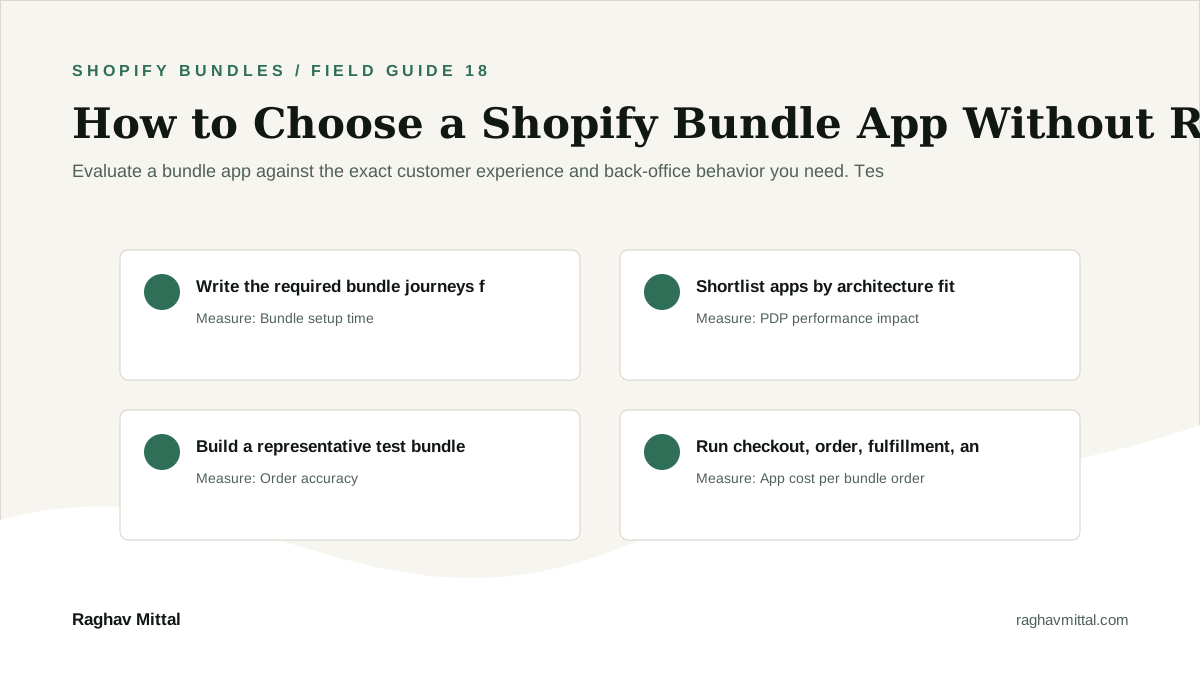
Evaluate a bundle app against the exact customer experience and back-office behavior you need. Test theme weight, component inventory, discount interactions, order lines, returns, subscriptions, analytics, and uninstall risk.
That is the short answer. The practical work begins by translating the promise into a journey the customer can understand and a workflow the team can operate. This guide is written for shopify merchants evaluating bundle apps beyond star ratings and feature lists.
Why this matters now
Bundles can increase average order value, improve curation, and move inventory, but they also change product modeling, inventory, discounts, fulfillment, returns, reporting, and app dependencies. The right architecture begins with the customer and operating model.
Shopify supports fixed and customized bundle approaches. Native Shopify Bundles is designed for fixed bundles and multipacks. Mix-and-match and subscription bundle requirements need a compatible third-party or custom approach. Native bundles are not compatible with selling plans, and Shopify Scripts were sunset on June 30, 2026.
The useful question is not whether a feature exists. It is whether the feature fits your catalog, customer expectation, margins, team ownership, data, and failure recovery. A technically valid setup can still create a poor customer experience or a costly back office.
Diagnose the current system before changing tools
Start with one real customer or order journey. Follow it from the first signal through every system, person, decision, and exception. Use evidence from the store, support inbox, operations team, and financial outcomes instead of relying on the intended process.
- What exact customer or business problem should this change solve?
- Which data is trusted, and which system is the source of truth?
- Who owns normal execution, and who handles an exception?
- Which promise, margin, privacy, or compliance rule must never be violated?
- What baseline will prove the new setup is better?
Write the answers in plain language. If the team cannot agree on them, implementation should pause. That disagreement is useful evidence that the process needs design before it needs another app or workflow.
The implementation playbook
1. Write the required bundle journeys first
This step turns the strategy into an operating decision. Write down the input, the person responsible, the expected action, and the exception that should stop the workflow. For best shopify bundle app selection, vague ownership is usually more expensive than a missing feature.
Test the rule with normal cases, incomplete data, duplicate events, and a realistic failure. Keep the first version narrow enough that the team can explain it. Use Bundle setup time as one signal that the step is creating business value rather than merely producing activity.
2. Shortlist apps by architecture fit
This step turns the strategy into an operating decision. Write down the input, the person responsible, the expected action, and the exception that should stop the workflow. For best shopify bundle app selection, vague ownership is usually more expensive than a missing feature.
Test the rule with normal cases, incomplete data, duplicate events, and a realistic failure. Keep the first version narrow enough that the team can explain it. Use PDP performance impact as one signal that the step is creating business value rather than merely producing activity.
3. Build a representative test bundle
This step turns the strategy into an operating decision. Write down the input, the person responsible, the expected action, and the exception that should stop the workflow. For best shopify bundle app selection, vague ownership is usually more expensive than a missing feature.
Test the rule with normal cases, incomplete data, duplicate events, and a realistic failure. Keep the first version narrow enough that the team can explain it. Use Order accuracy as one signal that the step is creating business value rather than merely producing activity.
4. Run checkout, order, fulfillment, and return tests
This step turns the strategy into an operating decision. Write down the input, the person responsible, the expected action, and the exception that should stop the workflow. For best shopify bundle app selection, vague ownership is usually more expensive than a missing feature.
Test the rule with normal cases, incomplete data, duplicate events, and a realistic failure. Keep the first version narrow enough that the team can explain it. Use App cost per bundle order as one signal that the step is creating business value rather than merely producing activity.
5. Measure performance and document exit risk
This step turns the strategy into an operating decision. Write down the input, the person responsible, the expected action, and the exception that should stop the workflow. For best shopify bundle app selection, vague ownership is usually more expensive than a missing feature.
Test the rule with normal cases, incomplete data, duplicate events, and a realistic failure. Keep the first version narrow enough that the team can explain it. Use Bundle setup time as one signal that the step is creating business value rather than merely producing activity.
Common mistakes to avoid
- Choosing an app before defining the bundle type. Record the consequence, the owner, and the prevention or fallback so the same failure does not become recurring manual work.
- Testing the PDP but not order and fulfillment behavior. Record the consequence, the owner, and the prevention or fallback so the same failure does not become recurring manual work.
- Stacking discounts without contribution-margin controls. Record the consequence, the owner, and the prevention or fallback so the same failure does not become recurring manual work.
- Ignoring performance, analytics, and uninstall residue. Record the consequence, the owner, and the prevention or fallback so the same failure does not become recurring manual work.
A controlled pilot is cheaper than repairing a broad rollout. Start with one product group, one workflow, one segment, or one customer journey. Keep a manual fallback until the evidence shows the new system handles normal and exceptional cases reliably.
How to measure whether it is working
Choose one primary commercial outcome, one customer-experience measure, one operational measure, and one guardrail. Review the measures together; a conversion lift that creates margin loss, support load, failed renewals, or fulfillment errors is not a clean win.
| Metric | How to operate it |
|---|---|
| Bundle setup time | Define the source, reporting frequency, baseline, target, and person responsible for acting when this moves. |
| PDP performance impact | Define the source, reporting frequency, baseline, target, and person responsible for acting when this moves. |
| Order accuracy | Define the source, reporting frequency, baseline, target, and person responsible for acting when this moves. |
| App cost per bundle order | Define the source, reporting frequency, baseline, target, and person responsible for acting when this moves. |
A focused 30-day rollout
- Week 1: Baseline and map. Document the current journey, owners, data, failure points, and the four baseline metrics above.
- Week 2: Configure and test. Build the smallest complete version, test realistic cases, and document the manual fallback.
- Week 3: Controlled release. Launch to a limited product group, segment, market, or internal team and watch every exception.
- Week 4: Review and standardize. Compare results with the baseline, fix failure patterns, train owners, and decide whether to expand, revise, or stop.
This sequence protects the team from app-first implementation. It also creates a clean decision record: why the system exists, what it is expected to change, who owns it, and what evidence justifies more investment.
Frequently asked questions
What is the best place to start with best shopify bundle app selection?
Start with one high-friction customer or operating journey, establish a baseline, and implement the smallest complete change with a named owner and fallback.
Which metrics should a Shopify team track?
Track Bundle setup time, PDP performance impact, Order accuracy, and App cost per bundle order. Review customer, margin, and operational guardrails together.
Do I need custom development?
Not always. Shopify Bundles can often begin with native or app configuration. Custom development is justified when the required journey, data rules, integrations, controls, or scale cannot be delivered reliably with the existing stack.
Primary documentation reviewed
Platform capabilities and compatibility can change. Review the current official documentation before implementation, especially for payment, checkout, selling-plan, inventory, privacy, and plan-specific behavior.
- Shopify product bundle overview
- Shopify bundle eligibility and considerations
- Shopify Bundles app
- Shopify developer bundle architecture
The bottom line
Evaluate a bundle app against the exact customer experience and back-office behavior you need. Test theme weight, component inventory, discount interactions, order lines, returns, subscriptions, analytics, and uninstall risk. Start with the operating decision, test the full customer and back-office journey, and measure the result against a real baseline. That is how Shopify Bundles becomes durable leverage instead of another layer the team has to remember.
Shopify & Conversion Websites
I help D2C and service businesses improve Shopify stores, landing pages, funnels, tracking, and conversion-critical templates.